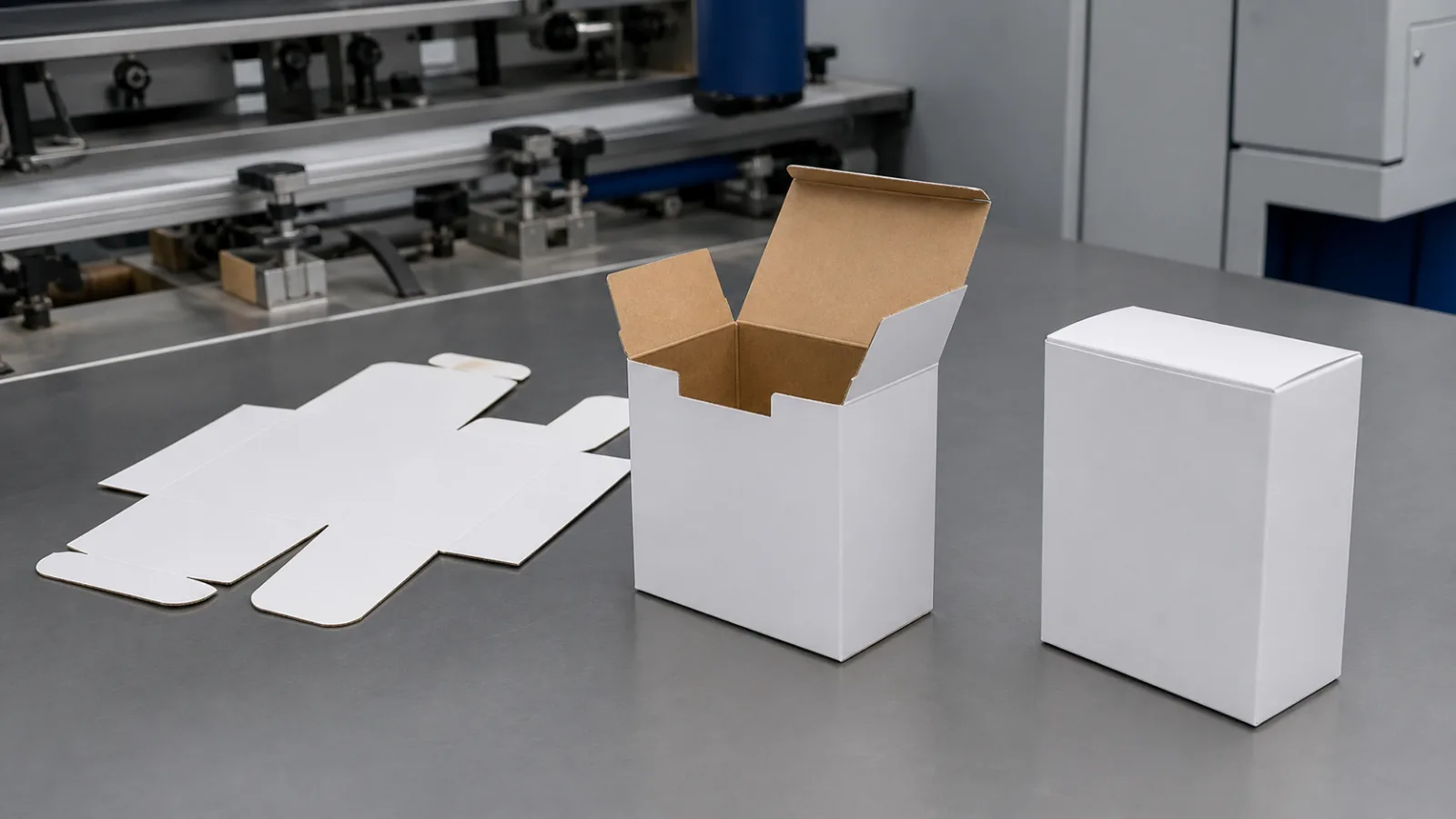


ECT and burst strength describe different ways corrugated board can fail. An edge crush test, or ECT, indicates the edgewise compressive resistance of combined corrugated board. Burst strength indicates resistance to rupture when pressure is applied through the board surface. Neither number, by itself, states how much product a finished shipping box can safely carry or how it will perform through a distribution cycle.
The distinction matters because a box can fail by vertical compression in a warehouse stack, by puncture during handling, by damage at scores and joints, or by a combination of moisture exposure, vibration, impacts, and poor load fit. A specification should therefore relate the board property to the likely hazard, then confirm performance on the finished pack where the risk justifies it.
ASTM D5639/D5639M frames this as a performance-selection problem: choose fiberboard and box attributes that are relevant to containment, storage, handling, transport, and protection. That is more useful than treating one board rating as a universal measure of box quality.
What ECT and burst strength actually measure
ECT measures the force required to crush a specimen of combined corrugated board loaded on its edge, with the flutes oriented vertically during the test. The result is commonly stated as force per unit width, often pounds-force per inch in North American specifications. It is a board-level indication of resistance to edgewise compression, not a direct finished-box load rating.
This makes ECT relevant when a box must resist compressive loading from stacking. A box in a palletized load transfers much of the vertical load through its corners and panels. Board with greater edgewise compressive resistance may support stronger box compression performance, but the relationship depends on the completed box and its condition.
Burst strength is measured differently. A restrained specimen is subjected to increasing pressure until the board ruptures. The result indicates resistance to pressure-driven rupture through the board surface. In corrugated purchasing language, burst specifications are sometimes called Mullen ratings, after a commonly used type of burst-testing apparatus.
Burst resistance can be relevant where rough handling, abrasive contact, concentrated impacts, or puncture-related damage are material concerns. It does not directly characterize how a tall regular slotted container will perform under a long-duration warehouse stack.
Both measurements concern corrugated material, but they examine different failure modes:
| Property | Primary failure mode indicated | Most relevant question it helps answer | What it does not establish alone |
|---|---|---|---|
| ECT | Edgewise crushing of combined board | Does the board have a stated level of edgewise compression resistance? | Finished-box compression capacity, allowable stack height, or shipment survival |
| Burst strength | Rupture of board under increasing surface pressure | Does the board resist a stated pressure-driven rupture mechanism? | Corner strength, stack performance, or resistance to every puncture event |
A published rating is therefore an input to package engineering, not a complete prediction of distribution performance.
Why a high ECT rating does not guarantee a high burst result
ECT and burst testing load the board differently. ECT concentrates on the board’s ability to carry load through the flute structure and liners while loaded edgewise. Burst testing examines the ability of the board structure to resist rupture under pressure. The same construction changes will not necessarily affect both results in the same direction or by the same amount.
Corrugated board is a system of linerboard, corrugating medium, adhesive bonds, flute geometry, and manufacturing conditions. Important variables include:
- Liner properties and construction. Liner grade, basis weight, fibre structure, and surface condition can affect rupture behavior and contribute to compression-related performance.
- Medium and flute profile. Flute height, spacing, orientation, and medium properties influence the board’s stiffness and crush response.
- Adhesive bonding. Inadequate bonds can create delamination or local weakness. A board may not behave as intended when loads reach the liner-medium interface.
- Wall configuration. Single-wall, double-wall, and triple-wall constructions should not be treated as equivalent simply because one headline rating appears similar.
- Converting quality. Scores, slots, die-cuts, glue joints, and crushed flute areas can reduce the performance of the erected box compared with an unconverted board specimen.
- Moisture and conditioning. Corrugated materials are sensitive to environmental exposure. A result obtained under defined conditioning may not represent board that has absorbed moisture during storage or transit.
The relationship between ECT and box compression is also not perfectly fixed. The paper Edge crush testing methods and box compression modeling specifically examines variation among ECT procedures and the limits of using ECT values as inputs to box-compression models. In practical terms, this means a nominal ECT value should be read alongside the test method, specimen preparation, conditioning, and box design rather than as an absolute prediction.
Likewise, a high burst rating should not be assumed to provide superior stack strength. A box may resist a burst test yet lose compression performance after humid storage, rough converting, panel buckling, or repeated distribution loads.
Match the rating to the distribution hazard
Start with the anticipated failure, not the legacy rating printed on a purchase order. The appropriate test plan depends on how the box is loaded, handled, stored, and recovered after delivery.
When compression is the principal risk
Compression-oriented evaluation deserves priority when the pack will experience pallet stacking, warehouse dwell time, floor loading, top loading during transport, or storage under variable humidity. ECT can be an appropriate board-control property in this situation, but a finished shipping-container compression test may be needed to validate the actual design.
Finished-box compression depends on more than board grade. Box length, width, and height affect panel stability. So do flute direction, score depth, manufacturer’s joint, closure method, contents support, and the degree of load sharing between the product and the box. A tightly fitting, rigid product may support some load; a loose or flexible product may not. Do not assume either condition without testing or documented engineering evidence.
When puncture or surface damage is the principal risk
Where boxes are exposed to sharp edges, unstable handling, rough manual transfer, or contact with protruding contents, burst resistance may be a useful part of the specification. It should still be matched to the actual hazard. A broad hydraulic burst test is not identical to a sharp puncture, a fork impact, or a tear beginning at a die-cut.
Consider whether the risk is better represented by a package drop, impact, vibration, or puncture-oriented evaluation. The test should reproduce the meaningful failure mechanism as closely as practical.
When the distribution route has several hazards
Most shipping systems combine compression, impacts, vibration, humidity changes, and handling damage. In these cases, a single ECT or burst requirement may be suitable for incoming-board control or commercial consistency, but it should not replace validation of the completed package.
The BioResources discussion of corrugated box specification and optimization makes the same broader point: no single metric captures all corrugated-box requirements. A performance specification needs to distinguish critical failures from cosmetic or acceptable damage and account for variation in materials and distribution conditions.
Read the specification as a box system, not a single number
A purchase specification that states only an ECT or burst value leaves important decisions undefined. It may allow nominally compliant board to be converted into boxes with materially different behavior.
For a usable corrugated-box specification, document at least the following where relevant:
- the required ECT, burst strength, or other material property, including units and test method;
- specimen conditioning requirements and the conditions under which acceptance testing applies;
- board construction, including wall configuration and flute profile where these are controlled;
- box style, internal dimensions, allowable dimensional tolerances, and flute orientation;
- score, slot, die-cut, hand-hole, vent, and closure details;
- joint type and adhesive or stitch requirements where applicable;
- contents, gross mass, internal fit, cushioning, and any expected product contribution to load support;
- pallet pattern, stack height, maximum storage duration, and whether loads are column stacked or interlocked;
- expected environmental exposure, including humidity-sensitive storage or transport stages;
- lot acceptance, sampling, retest rules, and the change-control process for paper, construction, converter, or design changes.
This level of detail does not require over-specifying every paper component. ASTM’s selection guidance cautions users to specify the attributes and related tests needed for their own operations and distribution cycle. The aim is to control meaningful performance variables, not to create a long list of requirements that adds cost without reducing risk.
Avoid generic wording such as heavy-duty corrugated or industrial grade unless it is tied to measurable construction and acceptance criteria. Those descriptions do not identify a test method, conditioning state, or failure threshold.
Use finished-package validation before changing grades or constructions
Changing from a burst-based grade to an ECT-based grade, or the reverse, is not a simple number substitution. Treat it as a controlled packaging change. The workflow below is useful whether the goal is cost control, material reduction, damage reduction, or a new distribution route.
- Document the current pack. Record the box style, dimensions, board construction, closure, contents, gross mass, pallet pattern, and current test requirements. Capture known failure modes rather than only complaint counts.
- Identify the principal hazards. Separate compression during storage from puncture, drops, vibration, moisture exposure, and unit-load instability. A complaint described as crushed may originate from poor pallet support rather than insufficient board strength.
- Define measurable pass criteria. State what constitutes failure: panel collapse, loss of containment, product damage, excessive deformation, seal failure, or an agreed cosmetic limit. Include the load configuration and conditioning state.
- Test the finished configuration. Where stacking is relevant, use an appropriate shipping-container compression evaluation. Where handling hazards dominate, select tests that represent the applicable drops, impacts, vibration, or environmental exposures.
- Inspect the failure mode. Note whether failure began at a corner, score, joint, panel, flute crush area, or internal load shift. This often identifies a more targeted correction than simply increasing a board rating.
- Repeat after meaningful changes. Revalidate when board construction, dimensions, converter, closure, contents, pallet pattern, storage conditions, or distribution route changes in a way that could alter performance.
ECT and burst tests can be useful quality-control tools for verifying specified material properties. They are not substitutes for a finished-package test when the actual risk is box compression, unit-load stability, product damage, or route-specific handling.
Questions to put in a corrugated box specification
Before approving a box, ask the converter, packaging engineer, or test provider these questions:
- Which failure hazard is this ECT or burst requirement intended to control?
- What exact test method, units, sample conditioning, and reporting format apply?
- Is the requirement for combined board, a converted blank, or an erected finished box?
- What wall construction, flute profile, box style, dimensions, and flute orientation are covered?
- What gross mass, contents configuration, and internal support condition does the approval represent?
- What pallet pattern, maximum stack height, storage duration, and environmental exposure are assumed?
- Which finished-package test determines approval when material ratings and package performance disagree?
- What sample plan, tolerance, lot-acceptance rule, and retest procedure apply?
- Which changes require requalification: paper source, flute construction, converter, dimensions, closure, contents, or distribution route?
ECT is generally more directly connected to edgewise compression resistance, while burst strength addresses a different rupture mechanism. Choose either rating only when it controls a relevant risk, and use finished-package validation when the consequence of failure depends on the real box, load, and distribution environment.
Frequently asked questions
Is ECT better than burst strength for corrugated shipping boxes?
Neither is universally better. ECT is often more relevant where stacking and compression are central risks. Burst strength may be useful where resistance to pressure-driven board rupture is relevant. The proper choice depends on box design, contents, handling, storage, and distribution hazards.
Can an ECT rating be converted directly to a burst-strength rating?
No general conversion should be assumed. The tests measure different failure modes, and results depend on board construction, papers, flute geometry, bonding, conditioning, and converting. Use a documented grade-specific equivalency only if it applies to the exact construction and intended use, then confirm the finished package.
Does a higher ECT rating tell me how much weight a box can hold?
Not by itself. Higher ECT may support stronger compression performance, but finished-box capacity also depends on dimensions, wall construction, scores, joints, moisture condition, load duration, pallet support, contents, and damage accumulated during handling.
Should corrugated-box approval include a compression test?
Include a finished-box compression evaluation when stacking or top-load failure is a meaningful distribution risk and the approval decision depends on compression performance. The test conditions should represent the actual box, contents, support condition, environment, and expected load duration rather than an arbitrary board rating alone.