
Paperboard grade names describe fibre composition and construction, but terminology varies by market. Buyers should connect the family name to a mill’s technical data rather than assume every board within a category has identical stiffness, shade or print surface.
Common families
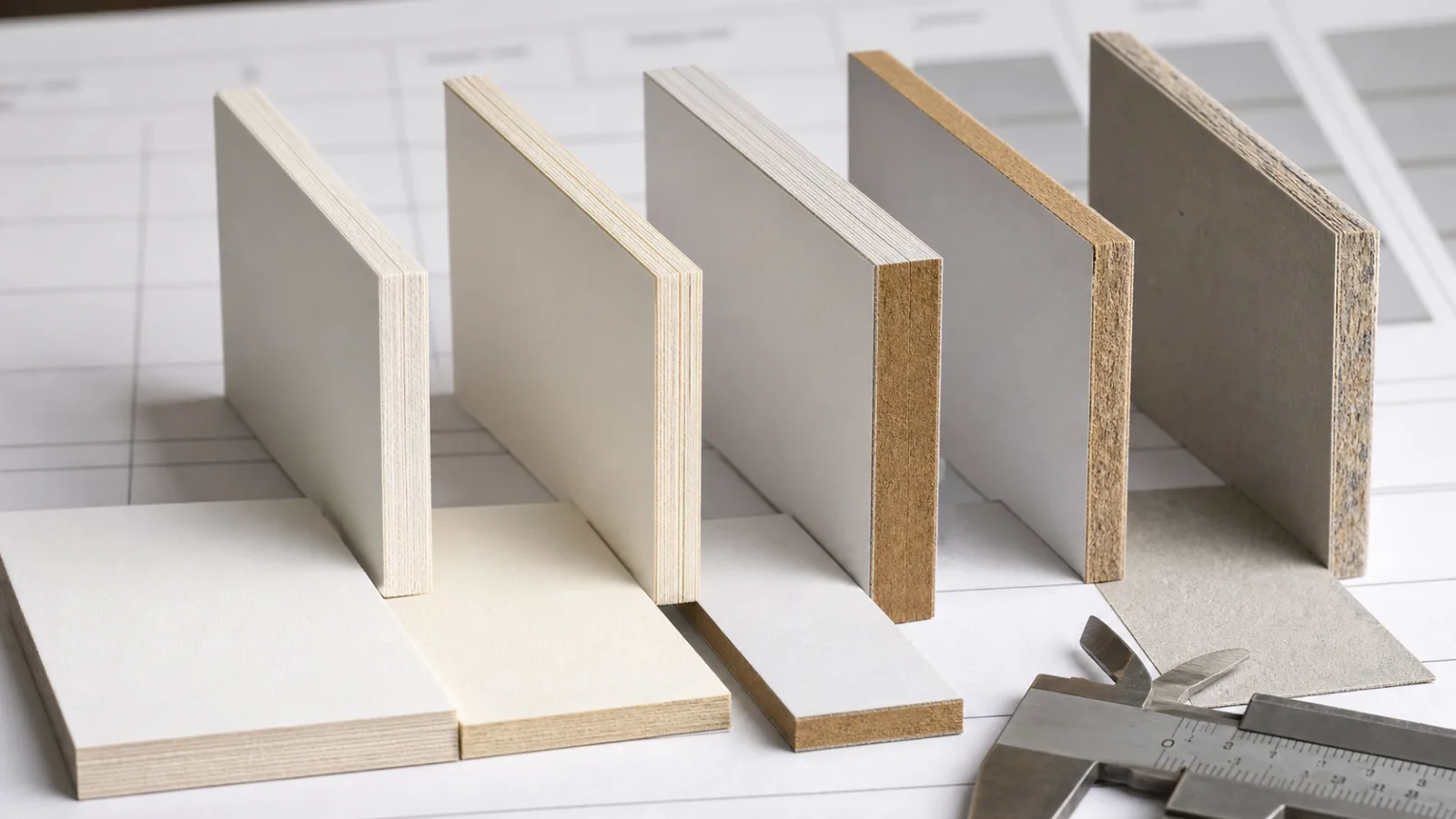
Solid bleached board uses bleached chemical pulp throughout and provides a clean surface and light-coloured reverse. Folding boxboard commonly combines chemical-pulp outer layers with a bulkier middle, balancing stiffness and weight. Solid unbleached board prioritises strength and usually retains a kraft shade. Recycled board uses recovered fibre and can include coated surfaces for print.
Each family spans different coatings, backs, bulk levels and food-contact positions. Recycled content alone does not predict cleanliness or final appearance.
Build a complete specification
State caliper, basis weight, stiffness direction, surface, shade, moisture and converting needs. Include scoring, embossing, foil, windowing and packing-line demands. For packaging reduction projects, compare board by the finished structure’s performance: a bulkier grade may achieve required stiffness at a lower basis weight, but it still needs trials for print, folding and distribution.
The main grade families
| Family | Typical construction | Practical strengths | Questions to resolve |
|---|---|---|---|
| Solid bleached board (SBB/SBS) | Bleached chemical pulp through the sheet, often coated | Clean white appearance, consistent surface, demanding print and finishes | Required purity, stiffness, cost and environmental documentation |
| Folding boxboard (FBB) | Chemical-pulp outer layers around a bulkier mechanical or chemi-mechanical middle | High bulk and stiffness-to-weight, strong graphic surface | Reverse shade, crease settings and end-use suitability |
| Solid unbleached board (SUB/SUS) | Predominantly unbleached kraft fibre, coated or uncoated | Strength, tear resistance and kraft character | Colour effect, print holdout and exposed reverse appearance |
| White-lined chipboard or recycled board (WLC/CRB) | Recovered-fibre middle and back with a white printable top | Efficient use of recovered fibre and a printable face | Grey or variable reverse, bulk, cleanliness and moisture sensitivity |
Abbreviations differ by region. A quoted family does not replace a mill datasheet. Ask for a physical proof and exact product identity.
Grammage, caliper and bulk
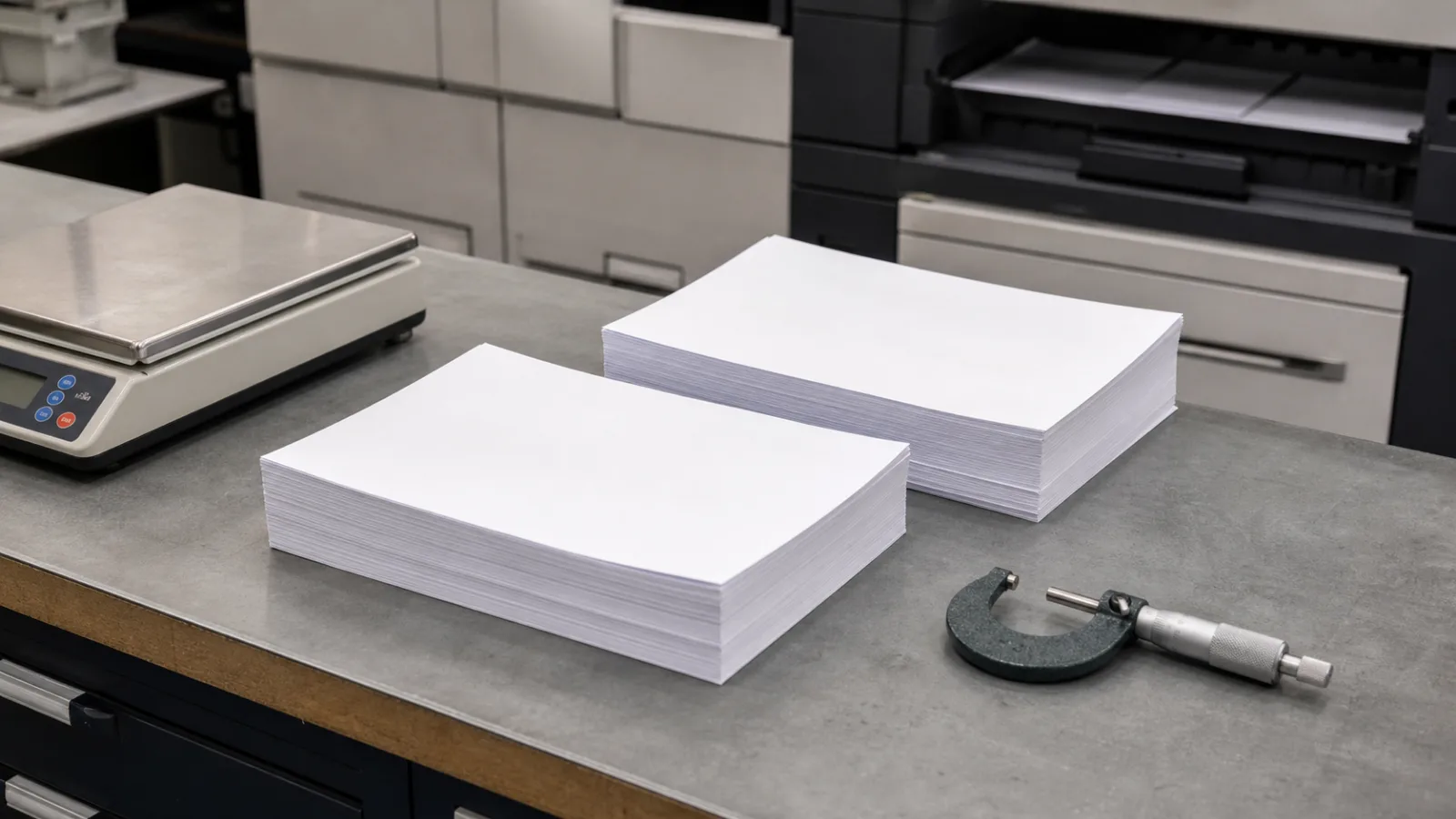
Grammage is mass per area; caliper is thickness. Their relationship is bulk. Carton rigidity often benefits from thickness, so a high-bulk multilayer board may reach a stiffness target at lower grammage than a dense sheet. That does not make a direct substitution automatic: tensile strength, tear, compression, moisture response and surface performance may change.
Stiffness is directional because fibres align during manufacture. Machine-direction and cross-direction values should be considered against carton panels and folds. Use the supplied sheet grain deliberately in the structural layout.
Surface and reverse side
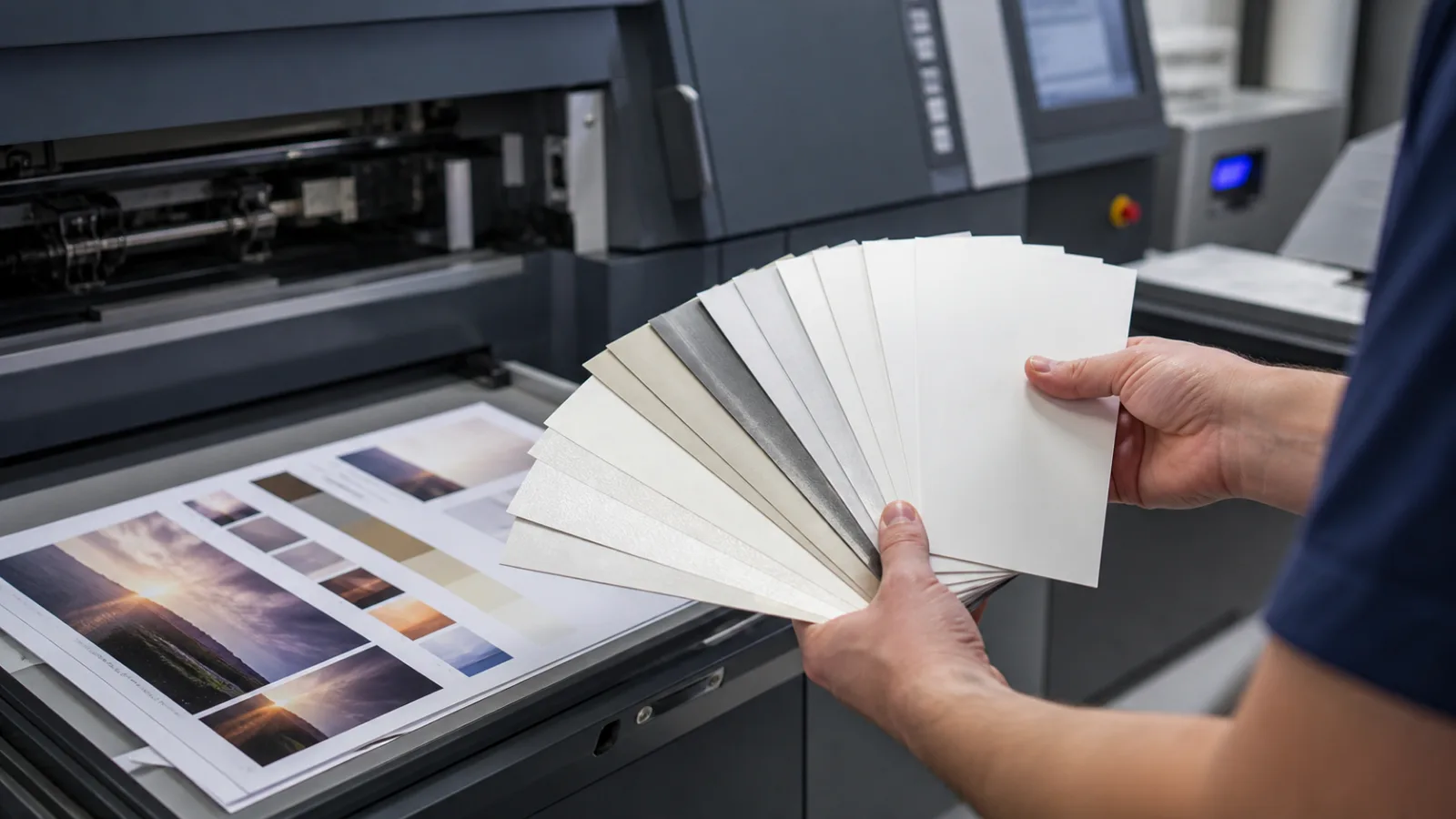
Coating smooths the print face and controls ink absorption. One-side-coated board may leave a cream, kraft or grey reverse visible inside the carton. If the design prints both sides or uses an open window, specify reverse shade and printability explicitly.
Brightness and whiteness affect colour appearance but are not universal quality scores. A natural or kraft shade can be a deliberate design choice. Review what coated paper does when deciding between image reproduction and tactile character.
Converting behaviour
Creasing, folding and die-cutting depend on caliper, fibre structure, grain and moisture. Dense solid board and bulky multilayer board need different crease channels. Coating and heavy print can crack over a fold. Foil, embossing, window film and glue introduce surface-adhesion requirements.
Do not approve a board from a flat print alone. Convert production-equivalent proofs and erect the pack. The folding carton production guide follows the full route.
Barrier and compliance layers
Food, frozen, chilled or greasy products may need sizing, extrusion coating, dispersion coating or another barrier. The barrier can affect printing, sealing, odour, migration, repulping and compostability. Ask for performance under a named test and documentation relevant to the intended product and country. A fibre base does not by itself prove suitability.
Build a specification that survives reordering
Include:
- manufacturer and grade name;
- grammage, caliper and permitted tolerances;
- coating configuration, finish and shade on both sides;
- machine and cross-direction stiffness where structural performance matters;
- sheet size and grain direction;
- moisture and storage requirements;
- print, foil, emboss, score, glue and barrier requirements;
- food-contact or chain-of-custody documentation when applicable;
- approved proof and substitution policy.
Qualifying a proposed substitute
Merchants may offer an equivalent when supply changes. Compare technical data, but also repeat print and converting trials. A sheet with the same GSM can have different caliper; the same caliper can hide different fibre or moisture behaviour. Test colour, drying, scoring, fold cracking, glue, packing-line efficiency and distribution.
For corrugated shipping structures, board grade language is different; kraft paper versus corrugated board explains liners, fluting and why a sheet cannot be compared directly with a constructed board.
The right paperboard family narrows the search. The final purchase decision belongs to a documented mill grade that meets print, structure, compliance and supply requirements after conversion.
Common specification mistakes
Do not write “300 GSM white board” and expect consistent cartons. That omits grade family, caliper, coating, reverse shade, stiffness and grain. Avoid substituting a micrometer reading taken at one point for the supplier’s controlled method. A board edge can be compressed, and conditioning affects the result.
Another mistake is approving only the outer face. Reverse-side colour can be conspicuous through openings and at tucked flaps. Print-through, odour and surface dust may matter to the packed product. A photograph under uncontrolled light is not a reliable colour reference.
Receiving checks
Verify labels and lot identity against the purchase order. Inspect wrapper damage, moisture exposure, edge condition, shade and flatness before converting. Keep material wrapped until conditioned for production, and separate suspect pallets rather than mixing them into a run.
Retain a converted reference from an approved lot. Incoming checks cannot replace mill data or a press trial, but they stop obvious substitutions and transport damage from becoming expensive finished cartons.