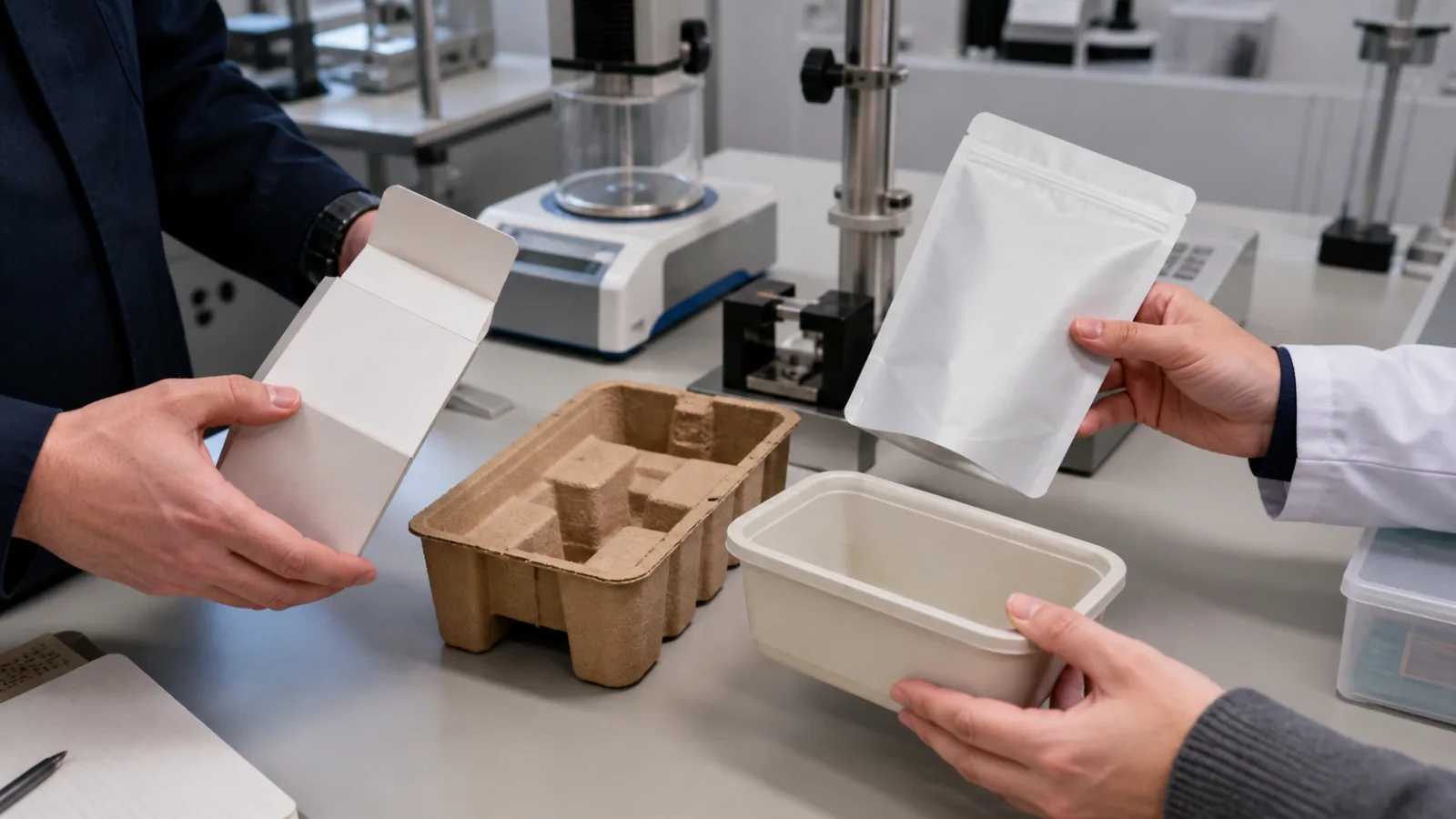


Paper packaging barrier coatings should be assessed against a defined recovery system, not described as universally recyclable. A coating may provide essential resistance to moisture, grease, oxygen or other product hazards, yet its recovery outcome depends on far more than its headline chemistry.
The relevant question is whether the complete converted pack can be collected, sorted, repulped and processed by the likely receiving system without causing an unacceptable loss of fibre or creating residues that the mill cannot manage. Base paper, coating coverage, adhesives, print, seals, labels, windows and closures all affect that answer.
Terms such as water-based, bio-based, dispersion-coated, plastic-free and compostable do not, by themselves, establish compatibility with paper recycling. They describe aspects of a material or formulation, not necessarily what happens during repulping, screening, reject handling or effluent treatment. Confirm performance for the exact pack construction and the intended market.
Start with the target recovery system
A package can be accepted into a paper collection stream while still being difficult for a particular paper mill to recycle. Collection acceptance, sorting capability and mill-process compatibility are connected but separate decisions.
Start by defining the route the pack is expected to take:
- Sales geography and relevant collection instructions.
- Whether household, commercial or food-service collection is involved.
- The intended material stream, such as mixed paper, corrugated packaging or a separately collected fibre stream.
- Whether the likely destination is a conventional paper mill or a specialist recycler.
- Whether the package is likely to be empty, clean and dry when discarded.
This matters because mills use different raw-material mixes, pulping conditions, screens, cleaning systems and end-product specifications. A mill making corrugated case material may assess contaminants differently from a mill making other grades. A local collector may accept an item because it is sorted further downstream; that does not prove that every receiving mill can use it.
The Confederation of Paper Industries’ design guidance highlights a particular challenge with two-sided laminated products in standard paper mills and notes that some structures may need separate collection and specialist reprocessing. That is a useful framing point, not a universal classification for all coated structures.
Avoid generic statements such as “recyclable in paper streams” unless the claim identifies the market, construction, collection route and evidence behind it. Where local instructions are important to a consumer-facing pack, verify them with the relevant operator, producer-responsibility organisation or authority at the time of approval.
Map the whole pack, not only the barrier
A barrier coating is one part of a packaging system. Before discussing recyclability, create a bill of materials for the finished item, including variations introduced during conversion.
Request the following information from the paper supplier, coating supplier and converter:
| Pack element | Information to identify | Why it matters in recovery |
|---|---|---|
| Fibre substrate | Paper or board grade, grammage, furnish where disclosed, wet-strength treatment | Influences fibre liberation, yield and recycled-fibre quality. |
| Barrier layer | Chemistry or material family, location, one- or two-sided coverage, coating weight or thickness | Affects how the barrier behaves during pulping and separation. |
| Print and finish | Ink system, coverage, primer, varnish, metallisation or other finish | Can add non-fibre material or affect process-water and quality considerations. |
| Adhesives and seals | Adhesive type, application pattern, seal area and opening features | Broad coverage or persistent fragments may affect separation and residue handling. |
| Components | Labels, windows, handles, spouts, closures, tapes and inserts | Components may be recoverable, removable or problematic depending on size and attachment. |
| Pack format | Flat wrap, pouch, tray, cup, carton or corrugated format | Geometry and bonded surfaces influence consumer emptying, sorting and repulping behaviour. |
The FEFCO recyclability guidelines describe the functional role of coatings, films, laminations and ancillary polymeric components in fibre-based packaging. This is important context: these materials may be necessary to contain and protect a product, but their presence creates a recovery question that must be addressed at the package level.
Ask for construction drawings and composition declarations that relate to the exact commercial pack. A generic statement about a coating family is not enough if the production pack uses a different coat weight, an additional varnish, a heat-seal layer, printed decoration or a larger bonded component.
Assess repulping, screening and residues
In a paper mill, recovered packaging is mixed with water and mechanically agitated to liberate fibres. The mill then uses stages such as screening, cleaning and other separation processes to remove non-fibrous material. The practical issue is not simply whether the coating detaches. It is what form it takes after repulping and whether that material can be removed at the relevant process stage.
A barrier may remain as larger pieces that are captured as reject material. It may detach relatively cleanly from fibre. It may also fragment into smaller particles that are harder for a given screen or separation system to manage. Each outcome has different consequences for fibre yield, reject volume, process water and the quality requirements of the recycled sheet.
The CEPI recyclability guidance recommends preference for polymers and sealing agents that can be removed through conventional screening and managed by mill and effluent-water systems without compromising production or finished-product quality. This is a design direction, not proof that any particular polymer or application method will perform acceptably in every mill.
Two-sided barrier construction needs particular attention. The 4evergreen conventional-process annex notes that fragmentation behaviour of barriers on both sides of paper or board can affect the validity of technical recyclability evaluation and that laboratory and mill behaviour may differ. A one-sided coated sheet should therefore not be treated as evidence for a comparable two-sided structure.
The fibre substrate also matters. A strong, wet-strength or heavily treated paper may require different pulping conditions from an untreated grade. Product residues matter as well: a technically suitable dry-goods wrapper may present a different recovery challenge after contact with grease, food or moisture.
Read test evidence by method, sample and threshold
A test report is useful only when it says what was tested and how results were interpreted. Do not accept a pass statement without the underlying structure, method and decision criteria.
The Sustainable Packaging Coalition’s paper packaging report distinguishes between a test method and result thresholds. A complete protocol can include sample preparation, the test procedure, thresholds and a submission or review process. This distinction is essential: two reports using similar language may not have assessed the same construction or applied the same acceptance criteria.
For each report, check whether it identifies:
- The tested sample: base paper or board, barrier on each side, coating weight where available, adhesive, print, varnish, labels and other components.
- Sample preparation: whether the test used a coated sheet, a converted package or a representative post-use pack.
- Repulping conditions: equipment, consistency, temperature, time or revolutions, and any conditions that could affect barrier breakdown.
- Separation stages: screen sizes, cleaning stages and how rejects or non-fibre material were assessed.
- Measured outputs: fibre yield, visible residues, screening results, stickies-related observations or other stated measures.
- Acceptance thresholds: the applicable protocol, version and decision threshold rather than a bare “pass” label.
- Scope and limitations: whether the result applies only to the tested construction, test environment or intended fibre stream.
Research on evaluation of coated packaging papers describes repulping and screening as key parts of a standardised experimental framework and notes the need to interpret controlled conditions carefully. A coating-only trial may be a useful development-stage indicator, but it does not prove the performance of a printed, glued, sealed commercial pack.
If a supplier references a protocol, request the full test report or an auditable summary. Confirm that the report covers the current specification, not an earlier development sample. Any change in coating application, substrate, sealing layer, adhesive coverage or attached component can justify renewed review.
Use construction choices to reduce uncertainty
Good design does not mean eliminating every non-fibre material. It means making necessary materials visible in the specification and avoiding complexity that has no functional purpose.
Give added scrutiny to:
- Barrier layers on both sides of the substrate.
- Laminated constructions with broad bonded areas.
- Large labels, windows, handles, closures and tapes.
- Adhesives applied across wide surfaces rather than only where function requires them.
- Pack formats that are difficult to empty or flatten.
- Consumer-removable features that lack clear on-pack instructions.
A tear-off or peelable component may reduce the non-fibre burden entering the paper stream only if consumers can remove it reliably and are clearly asked to do so. The CPI guidance cautions that peelable laminates left attached can still affect recycled-material quality. Design teams should test whether removal is practical under ordinary use, then align disposal instructions with current local collection guidance.
Do not infer food-contact compliance, migration performance, product shelf life or recycled-content eligibility from recycling evidence. Those are separate technical and regulatory questions requiring their own documentation.
Buyer and designer checklist before approval
Use this workflow for a new barrier-coated paper pack or a material change:
- Define the target market and disposal route. Record the countries or regions, collection stream and likely recovery pathway. Treat local acceptance as time-sensitive information.
- Freeze the full package specification. Include the paper grade, barrier layer, print, varnish, adhesives, closures, windows and any consumer-removable parts.
- Request evidence for the exact structure. Prefer evidence for the converted pack over a claim for the barrier chemistry alone.
- Review the test method and thresholds. Check sample preparation, pulping conditions, separation stages, outputs and stated limitations.
- Compare evidence with the intended system. A test may support technical plausibility but not establish acceptance by every collector or mill.
- Confirm local collection communication. Verify whether disposal instructions are appropriate for the sales geography and format.
- Repeat the review after material changes. Reassess when coat weight, substrate, printing, sealing, adhesive pattern or attached components change.
A direct discussion with a likely receiving mill, recycler or local recovery organisation is appropriate when the pack has a two-sided barrier, a complex laminate, significant attached components, unusual residue risk or a high-volume application. Where commercial approval depends on a particular recovery route, consider a representative trial designed by the relevant technical parties rather than relying on a generic recyclability statement.
The most defensible selection rule is simple: specify the barrier-coated paper pack for its required product function, then assess its complete construction against the collection route and mill process it is actually expected to enter. If that route, construction or evidence is uncertain, describe the uncertainty and obtain further verification before making a recyclability claim.