
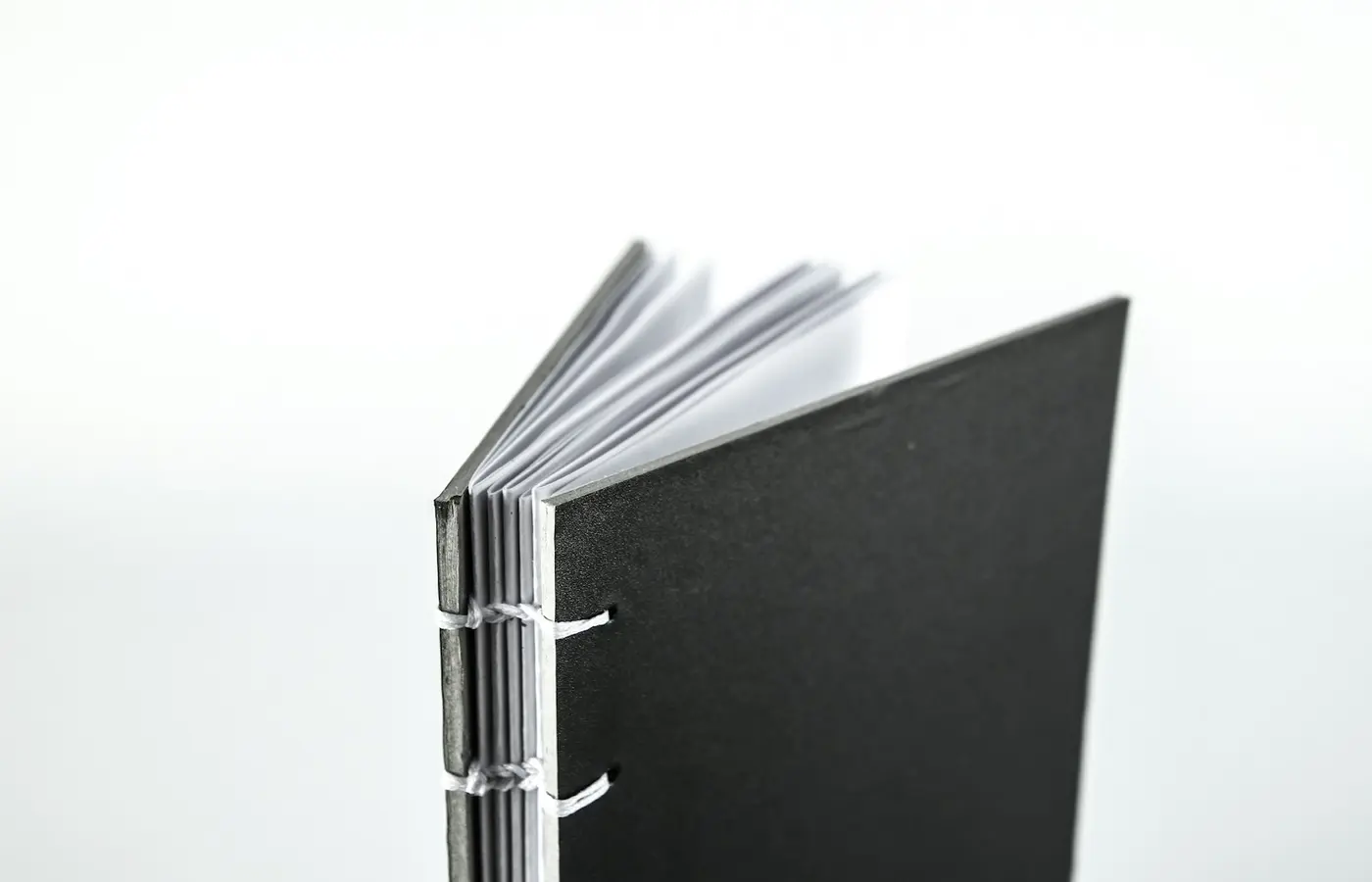
Paper grain direction is the predominant orientation of fibres formed as paper travels through the paper machine. It matters because paper does not bend, fold, stretch, or respond to finishing forces in exactly the same way in every direction.
For a printed job, grain direction should be considered alongside fold lines, book spines, sheet size, imposition, stock caliper, scoring, coating, ink coverage, and the finishing route. It is not a universal cure for cracking, curl, poor binding, or pressroom handling problems. It is, however, a variable that should be stated clearly before paper is ordered and before a folding or binding layout is approved.
The practical requirement is simple: identify the grain direction for the exact grade and sheet size, map it against the finished product geometry, and confirm the required orientation with the printer or bindery.
What paper grain direction means on a printed sheet
During papermaking, a web of wet pulp travels through the machine. Many fibres become preferentially aligned in the direction of travel. This is generally called the machine direction (MD). The direction across the web is the cross direction (CD).
On a cut sheet, grain is commonly described by its relationship to the sheet dimensions:
- Grain long means the predominant grain runs parallel to the long dimension of the sheet.
- Grain short means the predominant grain runs parallel to the short dimension of the sheet.
This naming describes the orientation in that particular cut size. It does not mean that every sheet with a longer side has grain running lengthwise. A merchant may offer the same nominal size in more than one grain orientation, and converting from a parent sheet can change the relationship between grain and the finished sheet dimensions.
PostPress explains the relationship between machine travel, fibre alignment, and grain terminology. Toronto Metropolitan University’s graphic-arts teaching material similarly describes grain as the orientation created while the web forms and identifies it on cut sheets as running along either the long or short side.
Directional behaviour can be measured in paper and paperboard. The scope of ASTM D528 identifies machine-direction determination as a formal test subject for most grades. That does not mean a buyer needs to run a laboratory procedure for every order. It does mean that grain is more than a visual convention or a generic assumption based on sheet dimensions.
For purchasing and production purposes, use the supplier’s stated grain direction for the exact grade, basis weight, finish, and sheet size. Treat informal shop-floor checks as confirmation tools, not as a substitute for product documentation when the job is critical.
Why fold lines and book spines need to be mapped to the grain
Paper fibres resist bending differently depending on the direction in which the sheet is folded. In common print terminology, a fold is often described as being with the grain when the fold line runs parallel to the dominant fibre direction. A fold running across the grain bends more fibres across their principal orientation.
This distinction is especially relevant where a product has a sharp, repeated, or highly visible fold. Typical examples include:
- folded brochures and leaflets;
- multi-panel direct-mail pieces;
- packaging inserts;
- signatures for sewn, adhesive-bound, or stitched books;
- covers that must wrap around a spine;
- heavy stock, board, or coated sheets that require scoring before folding.
Folding with the grain may reduce the tendency toward surface disruption, wrinkling, or fibre stress in some constructions. PrintIndustry’s folding and scoring primer describes grain as one reason a folded press sheet may be less prone to cracking, delamination, or wrinkling. This is useful production reasoning, but it is not a guarantee of fold quality.
A fold that performs poorly may involve several interacting causes. Caliper may be too high for an unscored fold. A score channel or rule may be unsuitable. Heavy ink coverage, varnish, lamination, coating, dry-back conditions, fold sequence, or folder settings may also change the result. The stock may have the preferred grain orientation and still require a revised score or a controlled production trial.
Book blocks, covers, and spines
For many bound products, a common starting preference is to run grain parallel to the spine. This can support more natural opening and reduce directional resistance as pages turn or as a cover wraps around its spine. It is a starting point, not a rule to apply without reviewing the construction.
The required orientation can differ between a text section, an endpaper, a cover, and an inserted component. A saddle-stitched booklet, a perfect-bound paperback, a case-bound book, and a lay-flat construction impose different demands on the substrate and assembly. Binding method, cover caliper, adhesive system, spine width, scoring pattern, and trim all need to be considered together.
Ask the bindery to state its grain requirement for the actual product rather than copying a general instruction from a previous job. This is particularly important when changing trim size, page count, paper grade, or binding method.
Grain direction in sheetfed printing and finishing planning
Grain direction becomes a planning variable before the press run begins. It can affect which sheet size is purchased, how pages are imposed, where fold lines sit on the parent sheet, and whether the desired finished orientation is commercially available in the selected stock.
A useful planning sequence is:
- Define the finished size, pagination, fold pattern, spine position, and finishing route.
- Mark fold lines, scores, glue areas, die-cut features, and critical visual panels on the flat layout.
- Establish the preferred grain orientation with the printer, binder, or converter.
- Select a press sheet and imposition that delivers that orientation after trimming and folding.
- Confirm that the paper grade is available in the required size and grain direction.
- Request a dummy, folded proof, or representative finishing check where the risk justifies it.
Do not assume that selecting a larger sheet automatically resolves the grain issue. A sheet may fit the press and yield efficiently while placing grain in an unsuitable direction for the finished fold or spine. Conversely, a sheet size with a more suitable orientation may create a different yield, press-format, or cost trade-off.
In sheetfed production, grain can also be relevant to how a sheet behaves through printing and downstream finishing. However, grain direction alone does not establish feeder reliability, register stability, delivery performance, die-cutting quality, or make-ready time. Those outcomes depend on the exact stock, press configuration, grain orientation, static control, sheet conditioning, coating, print coverage, gripper edge, machine settings, and finishing equipment.
For this reason, a production specification should distinguish between a documented requirement and an assumption. Write “grain long, parallel to finished spine” or “grain to run parallel to primary fold line,” where appropriate. Avoid vague notes such as “correct grain” unless the job ticket also defines what “correct” means for that layout.
Practical ways to identify and confirm grain direction
The most reliable first step is documentation. Check the mill datasheet, merchant listing, carton label, wrapping label, or delivery paperwork for the stated grain orientation. Confirm that the notation applies to the exact ordered sheet size rather than a related parent size or roll product.
Where documentation is absent, unclear, or inconsistent with the job requirement, use a controlled comparison check and escalate the result to the supplier, printer, or bindery before production approval.
A practical confirmation sequence
- Identify the exact stock. Record manufacturer, grade, basis weight or grammage, finish, caliper where relevant, and cut-sheet dimensions.
- Inspect supplied information. Look for explicit grain-long or grain-short notation and any ordering convention used by the merchant.
- Compare strips cut in both directions. Toronto Metropolitan University describes a strip-based “slump test,” using strips cut along the two dimensions of the sheet. The two strips may show different bending behaviour because of directional fibre orientation.
- Use simple checks cautiously. Tear and moisture-curl methods are commonly described in print guidance, including the PrintIndustry primer. They should be treated as comparative checks, not definitive methods for every coated, laminated, heavily sized, or board grade.
- Avoid damaging approved stock without authorisation. A destructive check can be unsuitable for limited or controlled production material.
- Record the result in job language. State the confirmed grain direction and its intended relationship to the fold, spine, or conversion feature.
- Resolve disagreement before running. If a shop-floor check conflicts with supplier documentation, do not silently choose one result. Confirm the grade and sheet size with the merchant or mill and involve the finishing owner.
Formal machine-direction testing exists, but the full procedure, conditions, and limitations of a standard should be reviewed before it is specified as a compliance requirement. Do not claim that a tear test, curl observation, or strip comparison demonstrates conformance to ASTM D528.
Questions to put on the purchase order and job ticket
A grain-direction preference is only useful when it is unambiguous. The following checklist can help turn a design or production preference into an actionable requirement.
- What is the exact stock grade, finish, grammage, and sheet size?
- Is the stock required grain long or grain short in that cut-sheet size?
- Which finished feature must align with the grain: primary fold, secondary fold, spine, score, wrap, or another conversion line?
- Is the intended relationship stated clearly, for example “grain parallel to spine”?
- Does the proposed imposition preserve that relationship after trimming and folding?
- Is the selected sheet size available in the required orientation from the named supplier?
- Will the stock be scored, perforated, die-cut, glued, laminated, varnished, or printed with heavy solid coverage near the fold?
- Does the printer or bindery require a folded dummy, scored sample, or production trial?
- Who approves the grain orientation if paper procurement, printing, and binding are managed by different parties?
- Where will the confirmed orientation be recorded: purchase order, estimate, job ticket, imposition approval, or finishing instruction?
For a repeat job, retain the approved stock identity and grain note with the production record. A later reprint can change materially if the paper grade, merchant, available sheet size, or bindery route changes.
When grain direction is not the whole diagnosis
An unsuitable grain orientation can contribute to folding or binding difficulties, but it should not be treated as proof of the cause. A sheet that prints cleanly may still resist a demanding folding operation, as noted in PaperIndex’s discussion of packaging-insert fold performance.
When a fold cracks, wrinkles, opens, or appears uneven, assess the full system:
- substrate construction, caliper, coating, and surface treatment;
- direction and depth of scoring;
- fold sequence and folder setup;
- ink, toner, varnish, laminate, or other surface build at the fold;
- conditioning and storage history;
- adhesive selection and application where binding is involved;
- press, finishing, and conversion settings;
- whether the issue occurs across the run or only in a particular panel, signature, or batch.
This approach keeps grain direction in its proper role: an important specification variable that needs to match the product geometry, not a catch-all explanation for every finishing defect.
Frequently asked questions
How can I tell which way the grain runs on a sheet of paper?
Start with the supplier’s carton label, datasheet, or merchant specification for the exact sheet size. If that information is unavailable, compare strips cut along each sheet dimension using a suitable shop-floor method, such as a controlled bending or slump comparison. Treat the result as a check and confirm uncertain cases with the supplier or bindery.
Should paper grain run parallel or perpendicular to a book spine?
For many book and cover constructions, grain parallel to the spine is a common starting requirement. The final instruction should come from the bindery for the actual stock, trim size, binding method, cover construction, and finishing route.
Does grain direction matter for every folded brochure?
It may matter less for a light, simple fold than for a heavy, coated, scored, multi-panel, or high-coverage piece. Even so, grain should be mapped to the fold layout when the job has visible folds, demanding finishing, or a narrow tolerance for defects.
How should grain direction be written on a print specification?
State the stock and sheet size first, then the required orientation and its relationship to the finished product. For example: “300 gsm coated cover, 700 × 1000 mm, grain direction to run parallel to finished spine; confirm with bindery before order.” The printer or merchant should confirm that the specified grade and size are available in that orientation.